New Online Book! Handbook of Mathematical Functions (AMS55) Conversion & Calculation Home >> Reference Information
Handbook of Mathematical Functions With Formulas, Graphs, and Mathematical Tables (AMS55) Purchase the electronic edition of this book in Adobe PDF format! FIRST | PREVIOUS | NEXT | LAST | CONTENTS | PAGE | ABOUT | SMALL | MEDIUM | LARGE
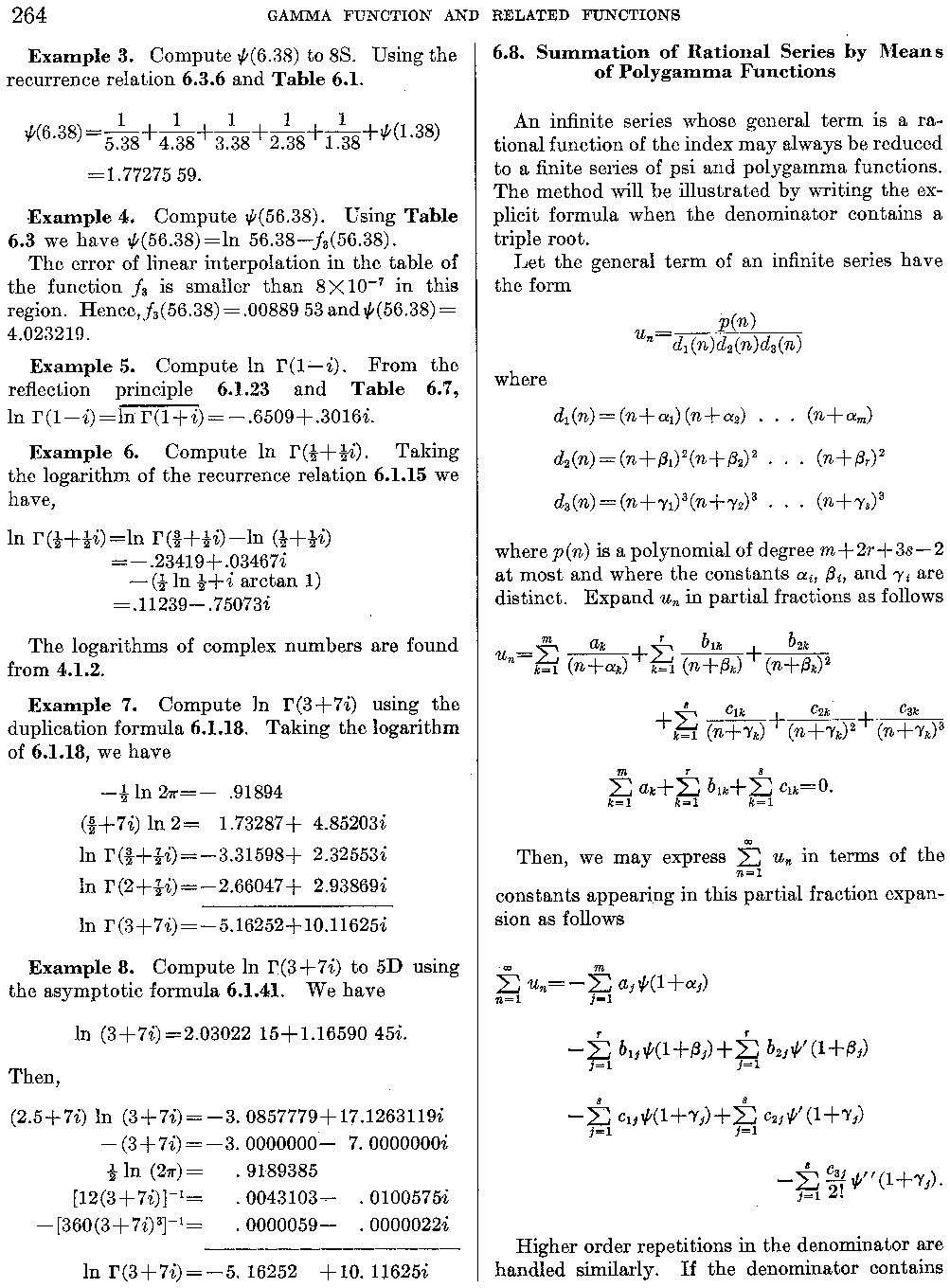
Below is the OCR-scanned text from this page: 264 GAMMA FUNCTION AN Example 3. Compute J.(6.38) to 8s. Using the recurrence relation 6.3.6 and Table 6.1. 1 1 1 1 1 J.(6.38) =-+-+-+-+--$J.(1.38) 5.38 4.38 3.38 2.38 1.38 =I .77275 59. Example 4. Compute lL(56.38). Using Table 6.3 we have J.(56.38) =In 56.38-f3(56.38). The error of linear interpolation in the table of the function f 3 is smaller than 8x10-’ in this region. Hence, f3(56.38) = .00889 53 andJ.(56.38) = 4.023219. Example 5. Compute In r(1-i). From the reflection principle 6.1.23 and Table 6.7, In r(1-i) =In r(1i-i) = -.6509+.3016i. Example 6. Compute In r(++$). Taking the logarithm of the recurrence relation 6.1.15 we have, In r (+++i) =In r (#+$)--In (+++i) - --.23419+.03467i - (8 In ++i arctan 1) = .11239- .75073i The logarithms of complex numbers are found Example 7. Compute In r(3+7i) using the duplication formula 6.1.18. Taking the logarithm of 6.1.18, we have from 4.1.2. -+ In 2r=- .91894 (3+7i) In 2= 1.73287+ 4.85203i In r(++&)=-3.31598+ 2.32553i In 1?(2+4i)=-2.66047+ 2.93869i In r (3+7i) =-5.16252+10.11625i Example 8. Compute In I’(34-74 to 5D using the asymptotic formula 6.1.41. We have In (3+7i)=2.03022 15+1.16590 4%. Then, (2.5f7i) In (3+7i)=-3. 0857779+17.1263119i - (3 + 7;) = - 3.0000000- 7. oooooooi 6 In (27r) = .9189385 [12(3+7i)]-’= .0043103- . 0100575.3 - [360(3+7i)3]-’= . 0000059- .0000022i In r(3+7i)=-5. 16252 $10. 116253 RELATED FUNCTIONS 6.8. Summation of Rational Series by Means of Polygamma Functions An infinite series whose general term is a ra- tional function of the index may always be reduced to a finite series of psi and polygamma functions. The method will be illustrated by writing the ex- plicit formula when the denominator contains a triple root. Let the general term of an infinite series have the form where where p(n) is a polynomial of degree m+2r+3s-2 at most and where the constants a,, or, and yl: are distinct. Expand un in partial fractions as follows m Then, we may express C u, in terms of the constants appearing in this partial fraction expan- sion as follows n=l -5 ?J.’’(1+r,). 2. Higher order repetitions in the denominator are If the denominator contains handled similarly.
The page scan image above, and the text in the text box above, are contributions of the National Institute of Standards and Technology that are not subject to copyright in the United States.
(800) 430-7532 | info@maps.com | Online Privacy Policy©2000 Maps.com. All rights reserved.Portions ©2000 ConvertIt.com, Inc. All rights reserved. Terms of Use.