New Online Book! Handbook of Mathematical Functions (AMS55) Conversion & Calculation Home >> Reference Information
Handbook of Mathematical Functions With Formulas, Graphs, and Mathematical Tables (AMS55) Purchase the electronic edition of this book in Adobe PDF format! FIRST | PREVIOUS | NEXT | LAST | CONTENTS | PAGE | ABOUT | MEDIUM | LARGE
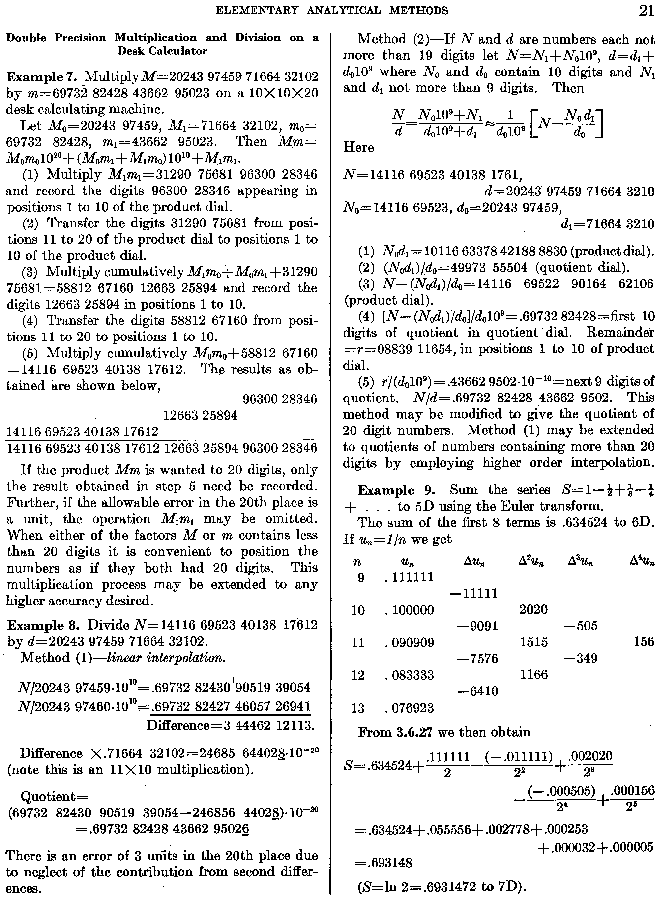
Below is the OCR-scanned text from this page: ELEMENTARY ANALYTICAL METHODS 21 Double Precision Multiplication and Division on a Desk Calculator Example 7. Multiply M=20243 97459 71664 32102 by m=69732 82428 43662 95023 on a 10XlOX20 desk calculating machine. Let M0=20243 97459, hfl=71664 32102, mo= 69732 82428, m1=43662 95023. Then Mm= Momo1020 + (Moml + Mlmo) 1O'O + Mlml. (1) Multiply M1ml=31290 75681 96300 28346 and record the digits 96300 28346 appearing in positions 1 to 10 of the product dial. (2) Transfer the digits 31290 75681 from posi- tions 11 to 20 of the product dial to positions 1 to 10 of the product dial. (3) Multiply cumulatively Mlmo+Moml+31290 75681=58812 67160 12663 25894 and record the digits 12663 25894 in positions 1 to 10. (4) Transfer the digits 58812 67160 from posi- tions 11 to 20 to positions 1 to 10. (5) Multiply cumulatively Momo+58812 67160 =14116 69523 40138 17612. The results as ob- tained are shown below, 9630028346 12663 25898 14116695234013817612 1411669523401381761212663258949630028346 If the product Mm is wanted to 20 digits, only the result obtained in step 5 need be recorded. Further, if the allowable error in the 20th place is a unit, the operation Mlml may be omitted. When either of the factors M or m contains less than 20 digits it is convenient to position the numbers as if they both had 20 digits. This multiplication process may be extended to any higher accuracy desired. Example 8. Divide N= 14116 69523 40138 17612 by d=20243 97459 71664 32102. Method (1)-linear interpolation. Nl20243 97459-1010= .69732 82430'90519 39054 N/20243 9746O.1O1O= .69732 82427 46057 26941 DifTerence=3 44462 12113. Difference X .71664 32102=24685 644028.10-20 (note this is an 11x10 multiplication). Quotient = (69732 82430 90519 39054-246856 44028). =.69732 82428 43662 95025 There is an error of 3 units in the 20th place due to neglect of the contribution from second differ- ences. Method @)-If N and d are numbers each not more than 19 digits let N=Nl+NolOg, d=dl+ dolog where No and do contain 10 digits and Nl and d, not more than 9 digits. Then Here N=14116 69523 40138 1761, d=20243 97459 71664 3210 No=14116 69523, do=20243 97459, d1=71664 3210 (1) Nod,= 10116 63378 42188 8830 (product dial). (2) (Nodl)/do=49973 55504 (quotient dial). (3) N-(Nod1)/do=14116 69522 90164 62106 (product dial). digits of quotient in quotient dial. Remainder =r=08839 11654, in positions 1 to 10 of product dial. (5) r/(dolO9)=.43662 9502.10-'O=next9 digitsof quotient. N/d= .69732 82428 43662 9502. This method may be modified to give the quotient of 20 digit numbers. Method (1) may be extended to quotients of numbers containing more than 20 digits by employing higher order interpolation. Example 9. Sum the series S=l-+++-i. + . . . to 5D using the Euler transform. The sum of the first 8 terms is .634524 to 6D. If un=lln we get n Un A u ~ A3un A'Un 9 .111111 (4) [N- (Nodl)/do]/dolOg= .69732 82428zfirst 10 -11111 10 .100000 2020 11 .090909 1515 156 12 .083333 1166 13 .076923 - 909 1 -505 - 7576 - 349 -6410 From 3.6.27 we then obtain .111111 (- .011111) .002020 S= .634524+-- 2 22 +-jr (- .000505) .000156 - 24 +,a = .634524+ .055556+ .002778+ .000253 = .693 148 (S=h 2 = .6931472 to 7D). + .000032+ .000005
The page scan image above, and the text in the text box above, are contributions of the National Institute of Standards and Technology that are not subject to copyright in the United States.
(800) 430-7532 | info@maps.com | Online Privacy Policy©2000 Maps.com. All rights reserved.Portions ©2000 ConvertIt.com, Inc. All rights reserved. Terms of Use.